
How Construction Loans Work in Arizona: Budget, Land, and Your Builder
Construction loans pay for a house that doesn't exist yet -- short term, money arriving in draws, interest on what's been spent, and one closing into your permanent mortgage. Part 1 of our Arizona series covers the budget, the land, and a builder you can actually verify.

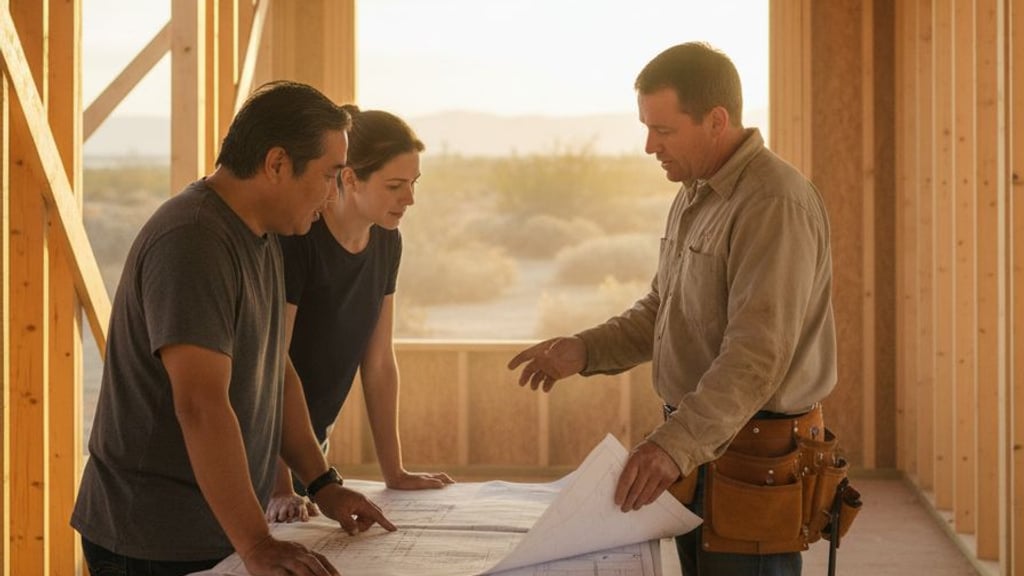
How Construction Loans Work in Arizona: Budget, Land, and Your Builder
AZ Construction to Permanent Loans · Part 1 of 3
A construction loan pays for a house that doesn't exist yet. That one fact explains everything unusual about them -- the short loan term, the money arriving in stages, and an appraiser placing a value on a home made of blueprints. Once the mechanics click, the rest of the process gets much easier to follow.
Five things separate a construction loan from the mortgage you'll live in later:
- It's short. The Consumer Financial Protection Bureau describes construction loans as "usually a short-term loan," typically carrying higher interest rates than the long-term loans used to buy finished homes (CFPB).
- The money arrives in draws. Rather than wiring you the full amount on day one, the lender releases funds "in a series of advances as the construction progresses," in the CFPB's words (same source).
- You pay interest on what's been drawn. While the house goes up, your payment usually covers interest only on the funds released so far, which is why the payment grows as the build does (Bankrate).
- The house gets appraised before it exists. The lender's appraiser values the finished home from your plans and specs. Part 2 of this series goes deep on that appraisal.
- One closing. Construction-to-permanent financing wraps the build phase and the mortgage into a single closing, so you qualify once and close once. Our Arizona construction loans guide covers that structure in detail.
One more rhythm note from the CFPB: payments on a construction loan sometimes start six to 24 months after the loan is made. Nothing about a normal mortgage prepares you for a loan that politely waits.
This is Part 1 of a three-part series. Part 2 covers how lenders qualify and close these loans, and Part 3 follows the money during construction. This one is the groundwork.
Your number comes first
Start with the money. Construction loans carry higher rates than regular mortgages, and during the build you're usually paying interest on draws -- often while also paying rent or a mortgage on the home you live in now. The number you can comfortably carry has to absorb both at once. The CFPB's plainest advice is to compare multiple loans, terms, and features before you commit, and a lender can size that for you in one conversation.
Know what the number is made of, too. Land, construction cost, the interest you'll carry while building, and a cushion for the things that change along the way. Build budgets almost always meet surprises; padding for them in advance is cheaper than financing them after the fact.
It's worth sizing honestly, because building is a real path in Arizona. In greater Phoenix, roughly one in five home sales is a newly built house -- about 21.5% of Maricopa County closings in late 2025, down from a peak of 23.6% in March 2024, per the Cromford Report's Nov. 22, 2025 observation on recorded Maricopa County deeds (via Real Estate Chandler).
Commercial money sites land on the same starting line. NerdWallet suggests getting prequalified for a construction loan before you spend serious time and money on building plans (NerdWallet). Design and bidding come later on this page, and the order matters -- money questions first keep you from falling for a floor plan the budget can't carry.
The land: own it or buy it at closing
Lenders want the land buttoned up by the time the loan closes. HUD's rules for FHA construction-to-permanent financing put it flatly. The borrower "must either be purchasing the land at the closing of the construction loan, or already own the land" (HUD Mortgagee Letter 2019-08, May 16, 2019, now carried in Handbook 4000.1). Other programs phrase it their own way, but the practical upshot is the same -- by closing day, the lot and the loan have to arrive together.
If you already own the lot, its value can count toward your down payment, and there's a clock on how much of it counts. When the lot has been owned six months or less, the creditable value is capped at what you paid for it, with the six months measured when FHA assigns the case number. Own it longer -- or receive it as an acceptable gift -- and its appraised value can count instead. The same HUD guidance lets that land equity help satisfy the minimum required investment, which is a genuinely useful break for buyers who bought their dirt early.
A lot bought well before the build is a job for a lot loan, and lot loans work differently from construction loans. LendingTree puts land-loan down payments at 15% to 35% depending on how developed the land is (LendingTree), and Rocket Mortgage runs from 15% to 20% on improved land up to 30% to 50% on raw land (Rocket Mortgage). Treat those as a wide band rather than a quote, since every lender sets its own terms -- and a future page on this site will give lot loans their own full treatment.
Before you close on any parcel, walk the unglamorous checklist. Confirm utilities reach or reasonably adjoin the lot, that there's legal access, that the city or county actually allows a single-family home there, and whether any easements cross the property. An hour of county records beats a year of owning a lot you can't build on.
The owner-builder one-year resale rule
Arizona lets you act as your own builder on a home meant for your own occupancy -- the owner-builder exemption in A.R.S. § 32-1121(A)(5). It comes with a timer. The statute says that a sale or rental of the home, or even an offer of one, "within one year after completion or issuance of a certificate of occupancy" is "prima facie evidence" that the project was undertaken for sale or rent. Prima facie means the presumption can be fought, but the practical effect is that the exemption falls away -- and the project can then be measured against the unlicensed-contracting penalties described below.
If you've heard that Arizona has a "three-year rule" for owner-builders, retire it. The statute says one year, and the clock starts at completion or at the certificate of occupancy, whichever applies to your project.
Finding a builder you can actually verify
Arizona's Registrar of Contractors keeps a public database of every license, and checking it takes about two minutes. In a state where building without a license is a crime, this is the cheapest background check you will ever run on the person managing your biggest purchase.
The check has five steps:
- Open the ROC contractor search. It's free and public, with no account needed. You can search by the company's name or by the six-digit license number printed on their paperwork, bid, or truck.
- Read the status line first. The ROC is blunt: a "CURRENT" license status is the only status that is legally able to contract, and the ROC sometimes displays the same standing as "ACTIVE." Everything else on the list (INACTIVE, SUSPENDED, REVOKED, WITHDRAWN, REJECTED) is a license you can't legally hire today.
- Check the classification. A B General Residential Contractor is licensed "to construct and repair all or any part of a residential structure or appurtenance," which is what a whole-home build needs. The dual-homebuilder licenses KB-1 and KB-2 also cover residential work. An electrician may carry a CR-11 -- that's an electrical classification, a trade license, and it's not a general builder's license.
- Read the rest of the record. The search shows the qualified parties and officers behind the license, former names and DBAs, the city of record, and bond information. Make sure the name on your contract matches the licensed entity -- the DBA list is right there to check against.
- Treat complaints separately. The contractor search shows license standing, and complaint status lives in the ROC's separate "Check a Complaint or Application Status" tool. A clean search result tells you the license is current. It doesn't tell you the whole history.
Arizona's definition of "contracting" is broader than people expect. Per the ROC, any business that contracts to build, alter, repair, add to, subtract from, improve, move, wreck or demolish a building needs a license (classifications). If the person running your build isn't licensed, the state has already defined the problem for you.
Your lender will check too. HUD's construction-to-permanent rules require the borrower to have "contracted with a builder to construct the dwelling," and that "the builder must be a licensed general contractor" (HUD Mortgagee Letter 2019-08). Programs that don't spell it out lean on the same instinct -- lenders want a builder whose business they can verify, and ROC status is how Arizona verifies one.
Then put the paperwork under the license. Get the license number written into the contract itself, along with a start date, a completion date, a clear scope of work, and a payment schedule tied to work actually completed. You'll need that signed contract for the loan anyway, which is a tidy alignment of interests -- the paperwork that protects you is the paperwork the lender requires.
What happens if your builder isn't licensed
The law doesn't treat this as a paperwork slip. Acting as a contractor without a license is a class 1 misdemeanor under A.R.S. § 32-1164, and the fines are written as minimums -- at least $1,000 for a first offense and at least $2,000 for a second or any later offense. If the court grants probation, it must order the contractor to repay all state, county, and local transaction privilege tax arising from the offense.
Advertising is covered on its own. Under A.R.S. § 32-1165, it's a class 1 misdemeanor to advertise that you can perform contracting work without first holding a license. The "we'll pull the permit under your name" arrangement some handymen propose doesn't cure that -- it usually just moves the risk to you.
For homeowners, the state's backstop is the ROC's Recovery Fund. A homeowner found eligible can recover a maximum of $30,000 per residence, and the Fund pays a maximum of $200,000 per residential contractor's license.
Two deadlines matter. An administrative claim generally runs two years after every appeal tied to the ROC's final order ends. A civil claim must be filed within two years of the contractor's act, or of the date you moved in.
The Fund serves homeowners who occupy or intend to occupy the home (and, in some cases, certain lessees and associations), and a claim against the contractor's bond has to be pursued first. That is one more reason the bond information on the contractor search page is worth a look before you sign.
The Recovery Fund exists because bad outcomes happen even when everyone means well. The cheapest insurance in this whole section is still the two-minute license lookup from the one before it.
Plans, specs, and the money you spend before the loan
The design phase runs on your money. Construction lenders finance the build itself. The design work that comes before the loan is on you. As Rocket Mortgage puts it, prospective custom-home builders "have to self-finance the design phase," and a lender won't take an application until a signed builder's contract, a construction timetable, the designs, and a realistic budget already exist (Rocket Mortgage, updated March 9, 2026). Bankrate's explainer says the same thing more briefly -- you or your general contractor supply the timeline, the detailed plans, and the budget (Bankrate, January 27, 2026).
The spec sheet is where a floor plan becomes a price. It's the document that says which cabinets, windows, and heating and cooling system the bid actually covers. Two builders can price the same plan thousands of dollars apart because their assumed specs differ. Get the spec in writing before you compare bids, or you're comparing menus from different restaurants.
Budget that stretch as real money. Design, engineering, and plan revisions all get paid before the loan exists, which is one more reason the number from the first section comes first. And know that the builder and the blueprint arrive together -- a builder's bid is priced off the plans, and the lender's file needs the signed contract -- so plan on producing them as a package rather than a relay race.
How long all of this really takes
The Census Bureau's Survey of Construction, analyzed by NAHB's Eye on Housing, puts the 2025 national average at 8.8 months from permit authorization to a finished house -- about 1.4 months waiting on authorization and another 7.4 months building (NAHB Eye on Housing, September 8, 2026; underlying data from the Census Bureau). Arizona sits in the Census Bureau's Mountain division, which averaged 9.1 months in 2025. Those figures run from permit authorization to a finished home, so add your design months in front. A realistic custom build is about a year from first sketch to keys.
Who swings the hammer moves the number. Homes built by companies for sale finished in 7.4 months on average in 2025, while owner-built homes took 14.3 months (same NAHB analysis). The owner-builder route from earlier in this page runs roughly twice as long as the production-builder route, and that's a real cost to weigh against the savings.
Permitting adds its own variable. Building codes are adopted city by city, and each permitting office sets its own review pace, so two similar projects on opposite sides of a county line can sit in queues for different lengths of time. Our Arizona construction loans page keeps city notes for Phoenix, Tucson, Scottsdale, and other markets around the state.
These figures are averages. Weather, labor, and change orders all push on them. If your mental model of a build is "a couple of months," stretch it.
Frequently asked questions
How does a construction loan work in simple terms?
You borrow against a house that doesn't exist yet. The lender approves the project, releases money in advances as construction progresses, and you pay interest on the funds drawn so far while the build runs. When construction finishes, the loan converts into your regular mortgage -- that's the construction-to-permanent structure our Arizona construction loans guide explains. The CFPB's construction loan explainer covers the basics.
Do I have to own land before I can get a construction loan?
Usually not. HUD's construction-to-permanent rules let you buy the land at the same closing as the construction loan (HUD Mortgagee Letter 2019-08), so owning the lot outright is not a prerequisite. Our Arizona construction loans guide covers the land rules in detail. If you're earlier in the process -- you've found a lot but you're months away from building -- lot loans exist for that gap, and the 15%-to-50% range above gives you a rough idea.
How do I check whether a builder is licensed in Arizona?
Search the ROC's free contractor database by the company's name or six-digit license number, and look for a CURRENT status (the ROC may also display ACTIVE), which is the only status legally able to contract. Then confirm the classification covers whole-home residential work -- B General Residential, or the KB-1/KB-2 dual licenses, per the ROC's classification list.
What is the penalty for contracting without a license in Arizona?
Acting as a contractor without a license is a class 1 misdemeanor under A.R.S. § 32-1164, with fines of at least $1,000 for a first offense and at least $2,000 for a second or later offense. Advertising unlicensed contracting services is a separate class 1 misdemeanor under A.R.S. § 32-1165.
Can I build my own house in Arizona and sell it within a year?
Be careful here. The owner-builder exemption covers a home you build for your own occupancy, but A.R.S. § 32-1121(A)(5) treats a sale or rental -- or an offer of either -- within one year after completion or issuance of the certificate of occupancy as prima facie evidence that the project was built for sale or rent. That presumption costs you the exemption and can expose the project to the unlicensed-contracting penalties above.
How much should I plan to spend before a construction loan even opens?
More than most first-time builders expect. A signed builder's contract, a construction timetable, the designs, and a realistic budget all have to exist before a lender will take the application (Rocket Mortgage, updated March 9, 2026), and the plans, engineering, and revisions along the way are paid out of pocket. Treat the design phase as its own line in your budget.
Building a house in Arizona is a long game played in short, checkable moves -- size the budget, secure the land, verify the builder, and let the drawings cost what they cost before the loan ever opens. None of the numbers here have to be guesses.
Call Michael George at AZWM at (480) 613-8040. Bring the lot address if you have one. We'll bring the checklist.
Michael George, NMLS #2280851 | Licensed in Arizona | Equal Housing Lender. Not a commitment to lend. All loans subject to credit approval.
Related Topics
Michael George
NMLS #2280851I'm an Arizona mortgage broker and I've helped buyers and homeowners across the state since 2001. I work with FHA, VA, Conventional, Jumbo, and USDA loans, plus refinancing — explaining every option in plain English so you can make the right call with confidence.
View more articles by this authorWhat Our Clients Say
Join thousands of happy homeowners who trusted us with their mortgage journey
Leon Bucci
FHA Loan"We are first time homebuyers, and we needed an FHA loan. We were pre-qualified for a great interest rate with only 3% down. We were so nervous, but our mortgage broker made us aware of all the pros and cons of several different mortgage programs. Call the Mortgage Genius-- 10/10!"
Michele Dutily
Refinance"Having a hard time finding the words to express how amazing my experience with Michael was. I will, however, refer anyone I know that is looking to purchase or refinance a home to Michael."
Judy Baeza
Multiple Loans"I had Michael George as my Mortgage Broker on two home loans & never worked with anyone so honest, helpful & competitively priced compared to other brokers I used."