
RefinanceMy Mortgage in Arizona
Lower your rate. Reduce your payment. Access your equity. Start saving today.

How Does Refinancing Work?
Mortgage explanations and FAQs by Michael George.

A mortgage refinance replaces your current home loan with a new one -- and the whole decision comes down to whether the new loan’s savings beat its costs. In practice you’re doing three things at once: paying off the old loan with a new one, resetting your rate and term to today’s market, and choosing what kind of new loan you actually want.
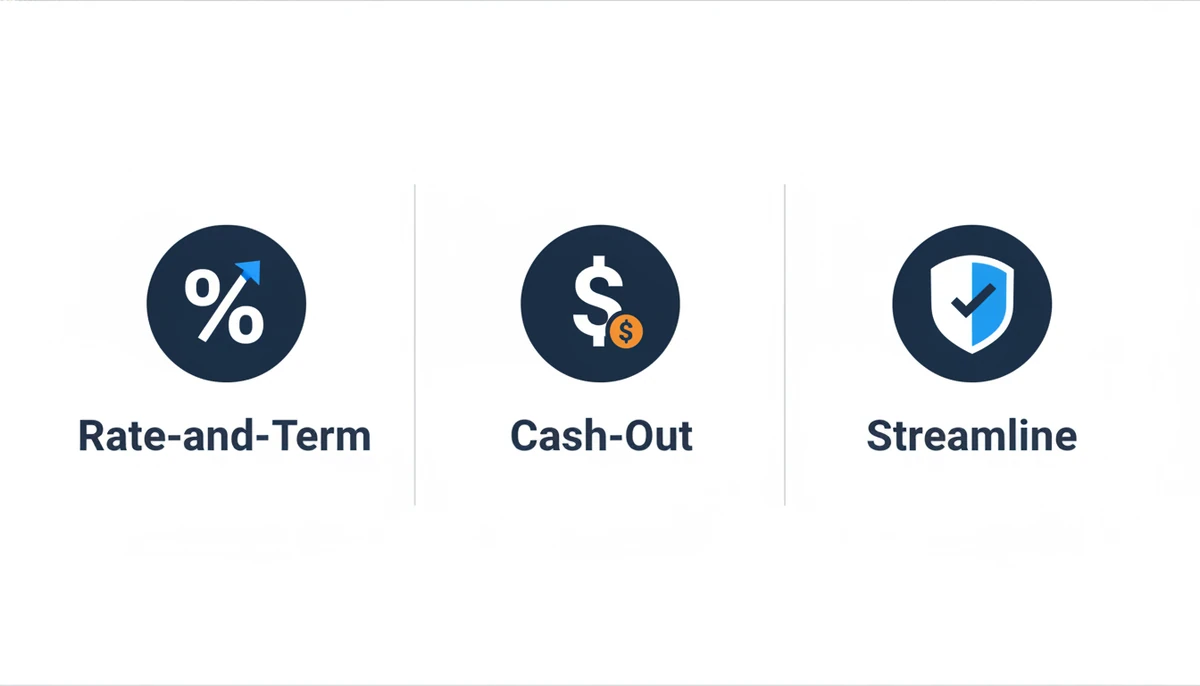
Most refinances fall into one of three shapes. A rate-and-term refinance changes your interest rate, your loan length, or both without touching your balance -- the classic move when rates drop or an ARM adjustment is coming. A cash-out refinance borrows more than you owe and hands you the difference as cash, at mortgage rates instead of credit-card rates. And the streamlined programs -- FHA’s Streamline and VA’s IRRRL -- are lighter-weight versions built for people already in those loan types, often with no appraisal and far less paperwork.
Three ways to refinance
Continue reading
The math that decides it
Every refinance asks one question: how many months until this pays for itself? Divide your closing costs by the monthly savings. Say a refinance costs $5,000 and saves $150 a month -- about 33 months to break even. Stay in the home past that point and everything after is savings; leave before it and the deal worked against you. That’s why the honest answer to "when should I refinance?" is never a rate alone -- it’s the rate, the costs, and how long you’ll actually keep the loan, in one calculation.
What it costs
Closing costs on a refinance typically run 3% to 6% of your loan principal. The big pieces are the appraisal, origination charges, and title work -- your Loan Estimate lays out every number before you commit, and it puts each lender’s quote in the same format so comparisons are real. Some lenders offer no-closing-cost refinances that trade a slightly higher rate for smaller upfront costs; compare both ways before you choose.
How long it takes
Most refinances close in 30 to 45 days from application. One date is set by federal rule: your Closing Disclosure arrives at least three business days before you sign, which protects you from last-second surprises. Build that buffer into any moving plans.
Which loan fits
Arizona homeowners refinance through every major program. Conventional loans suit borrowers with solid credit and equity; FHA refinances help borrowers with thinner credit or smaller down payments, with the Streamline path for existing FHA loans; VA refinances serve eligible veterans and service members, with the IRRRL as its streamlined version; and jumbo loans cover balances above the 2026 conforming limit of $832,750. Each has its own page on this site (linked just below) with the current rules, limits, and FAQs.
The honest trade-offs
A refinance is not free money. Closing costs come out of pocket or get rolled into the balance. Stretching a 27-year-old loan back to 30 years can lower your payment while slowing your equity building. And cash-out converts unsecured debt into debt your home secures -- the rate improves, but the stakes rise. None of these kills the deal; all of them belong in the math.
When it makes sense
The clean signals: rates sit meaningfully below yours, your credit has improved since you borrowed, you want out of an ARM, or you need your equity for something that outlasts the debt. If one of those is true, the next step is a conversation about your actual numbers -- which is exactly what we do with Arizona homeowners every day.
Why Refinance Your Mortgage?
Refinancing isn't just about rates—it's about reshaping your financial future.
Lower Your Rate
Even a small reduction in your interest rate can save you thousands over the life of your loan. Take advantage of market conditions to lock in a better rate.
Shorten Your Term
Move from a 30-year to a 15-year mortgage. Pay off your home faster and save significantly on interest.
Pay Off Faster
Refinance into a shorter loan and more of every payment attacks the principal instead of feeding interest. Yes, the monthly payment usually climbs — but you own your home years sooner, and the interest you skip over the life of the loan is where the real savings hide.
Cash-Out Equity
Access your home's equity for renovations, debt consolidation, or investment opportunities.
Access Your Cash
Refinance for more than you owe and take the difference as cash, at mortgage rates rather than credit-card rates. Arizona homeowners put it toward renovations, debt consolidation, and major life expenses. The trade-off: a bigger loan balance — so the best uses are the ones that outlast the debt.
Remove PMI
If your home value has increased to 20%+ equity, refinancing can eliminate PMI payments immediately.
Eliminate Fees
If you bought with less than 20% down, private mortgage insurance may be riding along on every payment — money that protects your lender, not you. When rising home values and shrinking balances push you past that 20% equity line, refinancing can retire PMI for good and lighten every payment that follows.
Lock Fixed Rate
Switch from an adjustable-rate mortgage to a fixed rate for predictable, stable monthly payments.
Payment Stability
An adjustable rate moves with the market — which means your housing budget moves with it, too. Refinancing to a fixed rate trades the unknown for certainty: the same principal-and-interest payment, month after month, for the life of the loan. If your next adjustment date is approaching, this is the conversation to have first.
Should You Refinance?
Refinancing isn't one-size-fits-all. The right choice depends on your current situation, financial goals, and how long you plan to stay in your home.
While lowering your payment and consolidating debt are common motivations, homeowners have multiple strategies available. Whether your goal is long-term savings, stability, or flexibility—refinancing can be a powerful tool.
Mortgage rates move in cycles, and refinancing is at heart a timing decision. When the market's going rate sits meaningfully below the rate you already hold, a refinance window opens; when it doesn't, patience is usually the winning strategy. The real question is never simply whether rates are low — it's whether rates are lower than yours, by enough to justify the cost of switching.
Four factors do most of the work in that decision: the gap between your current rate and your lender's current pricing, how long you plan to stay in the home, how much your credit profile has strengthened since you first borrowed, and the equity your home has built since. A wide rate gap paired with a long horizon is the classic green light; a narrow gap or a short horizon argues for waiting.
The break-even frame keeps the decision honest. Closing costs are the price of admission on any refinance, so divide those costs by the monthly savings the new loan creates — the answer tells you how many months it takes to simply get back to even. Stay past the break-even point and every month after it is pure savings; move or refinance again before it, and the deal worked against you.
Market conditions matter differently for adjustable-rate borrowers. If your ARM is moving toward its next adjustment, converting to a fixed rate is less about chasing a lower rate and more about buying certainty — locking in a payment that cannot move, whatever rates do next. In unsettled rate environments, that stability carries real value all by itself.
When pricing is favorable relative to your existing loan, a cash-out refinance can double as strategic financing: tapping your equity for renovations, debt consolidation, or major expenses at mortgage pricing instead of credit-card pricing. The discipline is the same in every market — weigh what the money does for you against the larger balance and longer payoff it leaves behind.
None of these signals means much in the abstract; they mean everything in your actual numbers. Compare your rate against your lender's current pricing, run the break-even math, and pressure-test the result against how long you'll really stay in the home. That analysis is worth doing before you sign anything — and it's exactly the conversation we have with Arizona homeowners every day.
Quick Savings Check
Cash-Out, Rate-and-Term & Streamline Options
Rate-and-Term Refinance
The classic refinance for better terms
Replace your existing mortgage with a new one that has a lower rate, different term, or both.
- May lower your interest rate
- Switch from an ARM to a fixed rate
- Shorten or extend your loan term
- Remove PMI with 20% equity
Cash-Out Refinance
Access your home's equity
Refinance for more than you owe and receive the difference in cash to use for any purpose. Conventional and FHA cash-out refinances typically cap at 80% of your home's value on a primary residence. VA cash-out allows up to 100% of the appraised value. Cash-out rates generally run slightly higher than rate-and-term refinances.
- Home improvements and renovations
- Consolidate high-interest debt
- Investment opportunities
- Emergency fund or education costs
80% caps: Fannie Mae Eligibility Matrix, HUD 4000.1 · VA 100%: va.gov
What Can Refinancing Do for You?
Discover how refinancing can help you achieve your financial goals.
Lower Your Monthly Payment
- Take advantage of lower interest rates
- Free up monthly cash flow
- Redirect savings toward other goals
- Make homeownership more affordable
Consolidate High-Interest Debt
- Pay off credit cards & personal loans
- Lower overall interest costs
- Simplify to one monthly payment
Shorten Your Loan Term
- Pay off your home years sooner
- Save tens of thousands in interest
- Build equity at an accelerated rate
- Own your home free and clear
Switch From ARM to Fixed Rate
- Lock in predictable payments
- Protect against future rate increases
- Reduce financial uncertainty
- Plan your budget with confidence
Remove Private Mortgage Insurance
- Eliminate PMI with 20%+ equity
- PMI often runs 0.5%--1.5% of the balance per year
- Keep more equity in your home
- Lower your total housing cost
Access Equity for Major Expenses
- Fund home improvements
- Pay for education costs
- Invest in opportunities
- Build an emergency fund
Mortgage Refinance FAQs
Get answers to the most common questions about mortgage refinancing.
When should I refinance my mortgage?
Refinancing makes sense when it meets a goal. A lower rate by itself may not cover the closing costs. The usual triggers: rates sit meaningfully below yours (lenders generally talk about a full percentage point or more), your credit has improved since you borrowed, you want a different term, or you need cash from your equity. The real test is break-even math. Divide your closing costs by the monthly savings, and the answer tells you how many months until the refinance pays for itself. Say you spend $6,000 in closing costs and save $200 a month -- 30 months to break even. Stay in the loan past that point and every month after is money in your pocket.
Sources: Freddie Mac -- Refinancing your mortgage · Federal Reserve -- Consumer’s Guide to Mortgage Refinancings
How much does it cost to refinance?
Plan on 3% to 6% of your loan principal in closing costs. The big pieces: the appraisal ($300--$700 is typical), origination charges (0% to 1.5%), and title search plus insurance ($700--$900). Some lenders offer no-closing-cost refinances that trade a slightly higher rate for lower upfront costs -- compare both ways before you choose.
Sources: Freddie Mac -- Costs of refinancing · Federal Reserve -- Consumer’s Guide to Mortgage Refinancings
How long does refinancing take?
Most refinances close in 30 to 45 days from application. The one date set by rule: your Closing Disclosure arrives at least three business days before you sign. Build that buffer into any moving plans.
Sources: Freddie Mac -- Refinancing your mortgage · Freddie Mac -- Closing your loan
What credit score do I need to refinance?
It depends on the loan. For a conventional refinance, many lenders look for 620 or higher. Automated approvals technically have no set minimum, but in practice lenders set their own floors. The best pricing typically starts around 780, not 740. FHA is more flexible: 580 and above unlocks maximum financing (500--579 caps the loan at 90% of your home’s value). And FHA’s Streamline Refinance can require no credit report at all.
Sources: Fannie Mae Selling Guide B3-5.1-01 · HUD -- Streamline Refinance
Can I refinance with negative equity?
Sometimes, yes -- two programs are built for it. An FHA Streamline doesn’t require an appraisal, bases the new loan on your existing balance, and sets no maximum CLTV. Negative equity alone doesn’t block you. You’ll need a recent on-time payment history (payments in the month due for six months, with at most one 30-day late) and a net tangible benefit. A VA IRRRL likewise requires no appraisal or credit underwriting package. A traditional refinance, though, generally needs you to hold some equity.
Sources: HUD -- Streamline Refinance · VA -- Interest Rate Reduction Refinance Loan (IRRRL)
Should I pay points to lower my rate?
A discount point costs 1% of your loan amount. How much it lowers your rate depends on the specific lender, the loan, and the market -- there’s no fixed exchange rate. The math that matters is your break-even. Divide what the points cost by the monthly savings, and see how many months it takes to win the money back. Worth knowing: Freddie Mac’s own research finds buying points often isn’t a significant financial benefit, so run your numbers before you pay them.
What documents do I need to refinance?
Lenders typically ask for recent pay stubs, two years of W-2s, two years of tax returns, and a few months of bank statements. Round that out with your current mortgage statement, your homeowners insurance declaration, and a photo ID (that one’s required at closing). Self-employed borrowers usually add profit-and-loss statements. Your Loan Estimate is the shopping document that matters -- it puts every lender’s quote in the same format so you can compare.
Sources: CFPB -- Applying for a mortgage loan · Freddie Mac -- Understanding the documents
Can I refinance multiple times?
There’s no legal limit -- VA even states plainly there’s no limit on how many times you can use your benefit. Each program has its own seasoning clock. FHA’s Streamline needs 210 days plus six payments since closing, among other conditions. A VA IRRRL needs six payments and 210 days measured from your first monthly payment. Cash-out refinances on conventional and FHA loans generally require the current loan to be at least 12 months old. Each refinance also brings fresh closing costs, so refinance when the math works -- not every time rates twitch.
Sources: eCFR 36.4306 -- VA refinancing loans · Fannie Mae Selling Guide B2-1.3-03
Refinance Calculators
See how much you could save with our interactive calculators.
Current Loan
New Loan
Refinance Analysis
New Payment
$899
Monthly Savings
$176
Break-Even
20 mo
Total Savings
-$69,257
Total Cost Comparison
Refinancing Recommended
You could save $176 per month and break even in 20 months. One trade-off: the longer term means the total you pay over the life of the loan goes $69,257 higher, even though the monthly payment drops.
Talk to an Arizona Refinance Expert
Take the first step towards better mortgage terms. Our experts are ready to guide you through every step of the refinancing process.
Refinancing an Arizona home? See Arizona refinance options